
Service
DGUV Regulation 3 (formerly BGV A3)
DGUV V3 is the central accident prevention regulation for electrical systems and equipment. We take care of the proper execution and legally compliant documentation for you, as well as support with deadline monitoring, so that you are always well protected during inspections by employers' liability insurance associations or insurance companies.


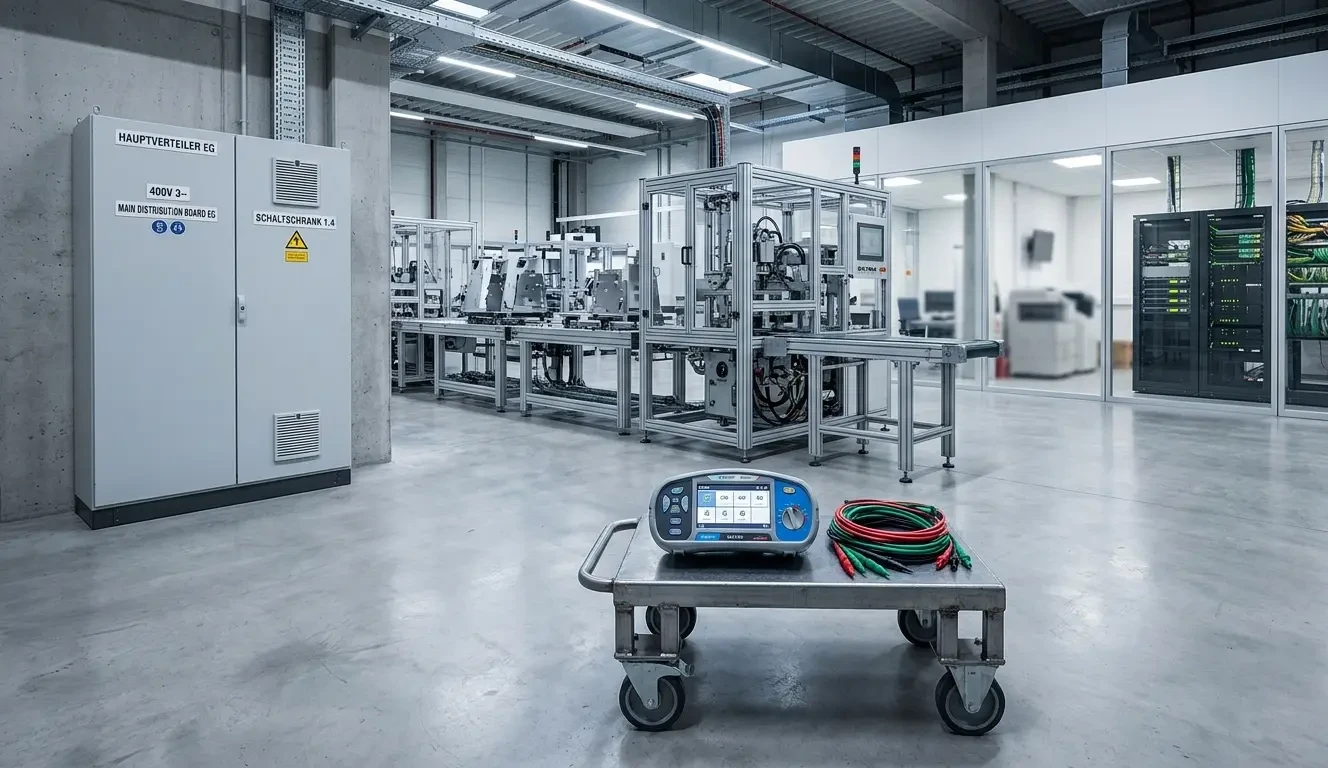
Legally compliant DGUV Regulation 3 inspection: liability protection & system availability
The compliant implementation of DGUV Regulation 3 (formerly BGV A3) forms the foundation for the safe and highly available operation of your entire electrical infrastructure. Whether it is a networked production plant, complex building management technology, or IT equipment – as the operator, you are under an absolute obligation under the German Ordinance on Industrial Safety and Health (BetrSichV) to prove the safety of your systems. In the event of damage without complete, standards-compliant documentation, allegations of organizational negligence are unavoidable, which can result in the loss of insurance coverage and the personal liability of management. Bittermann Elektrotechnik GmbH offers you a legally secure solution that significantly reduces your liability risks while disrupting your operational processes as little as possible.
Our inspection services in detail
As state-recognized experts, we inspect your entire electrical operating equipment – from portable devices to complex stationary systems and machinery in accordance with DIN VDE 0100-600, 0105-100 and 0113-1. Our measurement and testing portfolio includes precise analysis of protective conductor and insulation resistance, as well as validation of the exact tripping parameters of your RCD protective devices. We transfer all measurement data directly on site into an audit-proof database compliant with TRBS and create court-admissible inspection reports for you, including clear recommendations for action. We also actively support your responsible electrical specialists (VEFK) in the legally compliant definition and optimization of inspection intervals based on well-founded risk assessments in accordance with § 3 BetrSichV.
Portable or stationary: what is inspected
DGUV Regulation 3 distinguishes between two groups of electrical equipment. The classification determines the applicable standard, the scope of the inspection and the guideline interval:
Portable equipment can be moved while in operation or is regularly taken to a different place and connected via a plug – for example laptops, monitors, printers, coffee machines, kettles, extension leads, multi-socket outlets, cable reels and power tools. It is tested in accordance with DIN EN 50678 (VDE 0701) or DIN EN 50699 (VDE 0702). More: Inspection of portable electrical equipment.
Stationary installations and equipment are permanently fixed, or have no carrying device and are so heavy that they cannot easily be moved – for example main and sub-distribution boards, circuits and sockets, lighting, permanently connected water heaters, air-conditioning units and machines. They are tested in accordance with DIN VDE 0100-600 (initial verification) or DIN VDE 0105-100 (periodic inspection). More: Inspection of stationary equipment and Machines and interconnected systems.
How a DGUV V3 inspection works
Preliminary consultation: We clarify the scope, sites, access and operating hours, and then prepare a binding fixed-price quote. At this stage we also agree together whether, and which, parts can be inspected during ongoing operation.
Inventory: All equipment and installations are recorded – the basis for inspection planning and deadline monitoring.
Risk assessment and inspection intervals: We help you or your VEFK define the type, scope and intervals of the inspections in accordance with § 3 BetrSichV.
Visual inspection: Checking for externally visible damage to housings, cables, plugs, covers and protective devices.
Measurement: Protective conductor resistance, insulation resistance, protective conductor or touch current; for stationary installations also loop impedance and the tripping parameters of the RCDs.
Functional test: Equipment and protective devices are checked for proper function.
Labelling and inspection report: Inspected equipment is labelled and all results are documented in an audit-proof manner – including an assessment of defects and recommendations for action.
Deadline monitoring: Our digital inspection management system contacts you before the next inspection is due.
Inspection intervals under DGUV Regulation 3
DGUV Regulation 3 does not prescribe fixed intervals: under § 5, inspection intervals must be set so that defects that are to be expected are detected in good time. The basis is the employer's risk assessment (§ 3 (6) BetrSichV). The implementation instructions to § 5 give the following guideline values:
| Installation / equipment | Interval (guideline) | Type of inspection | Inspector |
|---|---|---|---|
| Electrical installations and stationary equipment | 4 years | for proper condition | Qualified electrician |
| Electrical installations and stationary equipment in “special locations, rooms and installations” (DIN VDE 0100 group 700) | 1 year | for proper condition | Qualified electrician |
| Protective measures with residual current devices in non-stationary installations | 1 month | for effectiveness | Qualified electrician or electrically instructed person using suitable measuring and test equipment |
| Residual current, differential current and fault voltage circuit breakers in stationary installations | 6 months | for function by pressing the test button | User |
| Residual current, differential current and fault voltage circuit breakers in non-stationary installations | every working day | for function by pressing the test button | User |
| Portable equipment, extension and appliance cords, connecting cables with plugs | 6 months, on construction sites 3 months; can be extended if the defect rate is below 2 % – up to a maximum of 1 year (construction sites, workshops, production) or 2 years (offices) | for proper condition | Qualified electrician; with suitable measuring and test equipment also an electrically instructed person |
Source: implementation instructions to § 5 DGUV Regulation 3 (tables 1A and 1B). Guideline values – the risk assessment of your business is decisive.
In addition, installations and equipment must be inspected before they are first put into operation and, after a modification or repair, before they are put back into operation (§ 5 (1) no. 1 DGUV Regulation 3).
Who is allowed to carry out the DGUV V3 inspection?
The inspection is reserved for a qualified electrician (Elektrofachkraft) – under § 2 (3) DGUV Regulation 3, a person who, on the basis of their professional training, knowledge and experience as well as knowledge of the relevant regulations, can assess the work assigned to them and recognize possible hazards. For the inspection of work equipment under the BetrSichV, the inspector must also be a person qualified to carry out inspections in accordance with TRBS 1203: vocational training in electrical engineering, professional experience, recent professional activity in the field of inspection and regular further training. Portable equipment may also be tested by electrically instructed persons using suitable measuring and test equipment, provided they work under the direction and supervision of a qualified electrician.
What happens if defects are found during the inspection?
Defects must be remedied without delay. If there is an imminent danger until then, the equipment or installation must not be used in its defective condition (§ 3 (2) DGUV Regulation 3). You receive a defect report from us immediately, with prioritized recommendations for action; after consultation, we can often carry out minor repairs directly on site. After a repair, the equipment is inspected again before it is put back into operation.
DGUV V3 inspection and E-Check: the difference
The DGUV V3 inspection is mandatory for companies with employees. It follows from the accident prevention regulation of the German statutory accident insurance and the BetrSichV; the employers' liability insurance association can request proof. The E-Check is a seal of approval of the German electrical trade, awarded by guild-affiliated electrical contractors – voluntary and common mainly among private households and landlords. For your business, what counts is not the name, but that the scope, standards, intervals and documentation meet the requirements of DGUV Regulation 3 and the BetrSichV. Bittermann Prüfservice inspects in accordance with DGUV Regulation 3 – we do not offer the E-Check.
Why Bittermann testing technology?
Certified experts: We act as highly specialized experts and BDSH e.V.-certified specialists, guaranteeing you inspection quality at the highest engineering level.
Legal certainty & TRBS compliance: Our court-admissible documentation stands up to any audit and fully protects your company against insurers and regulatory authorities.
Inspection during ongoing operation: Through innovative measurement methods and forward-looking planning, we carry out inspections with maximum efficiency and as little impact on your day-to-day business as possible. Inspection without switching off is possible in many cases – we clarify this in the preliminary consultation.
Relief for your specialists: We take over the complete inspection management, from inventorying to documentation, so that your internal experts can focus on their core technical work.
Secure your systems now
Delegate your inspection obligations to certified experts and make no compromises when it comes to operator responsibility. Contact us today for a non-binding initial consultation to develop an efficient inspection concept tailored precisely to your operational requirements.
Quick request
Request a quote for DGUV V3 inspection
A few key details are all we need. After a brief preliminary consultation, you will receive a fixed-price quote from us.
Your contact person

Dirk Lehmhaus
Project Manager, VEFK & BDSH e.V. Certified Expert


FAQ
Frequently asked questions.
Who does DGUV Regulation 3 apply to?

How often does the DGUV V3 inspection have to be carried out?
Who is allowed to carry out the DGUV V3 inspection?
Does the power have to be switched off for the inspection?
What happens if the inspection is missed?
Is an E-Check sufficient instead of the DGUV V3 inspection?
How much does a DGUV V3 inspection cost for our company?
Do you remind us of upcoming periodic inspections?


